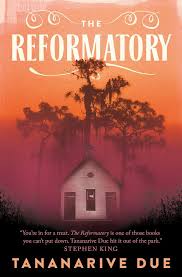
This is a novel that I’d recommend to everyone – in fact, I’ll be surprised if I don’t just rave about it face to face any time I can crowbar it into a conversation. It should be a massive crossover novel, and is one of the best things I’ve ever read.
It is set in 1950s Florida and tells the story of a brother and sister, Robert and Gloria. Robert is twelve years old and following a very innocuous incident with an older boy who happens to be the son of a rich and powerful man in the town, the police come to Robert’s door. He is taken to Court and given a very cursory trial and sentenced to six months at the Gracetown School for Boys, a reformatory.
The story then alternates between Robert’s time at the Reformatory, and Gloria’s efforts to make sense of the system and to fight within it for justice and being thwarted at every turn. The reformatory on the real world Dozier school, and just like that school lots of young African-American children were detained for very little, beaten, abused and many of them died as a result of systemic abuse and racism. Tananarive Due’s own Great-Uncle was in the Dozier school and died there, and the Robert character is based on him.
Robert also has the ability to see ghosts – or what the novel calls ‘haints’ and the reformatory is full of them – spirits of boys who died at the school, including many who died in a fire of ‘unknown’ causes. Discipline at the school is both ferocious and capricious, and every moment is charged with the knowledge that saying the wrong thing or having the wrong facial expression can at any time get you a trip to “The Funhouse” for a beating, or somewhere else for worse.
Robert and Gloria are both wonderful protagonists, kind-hearted and innocent but quickly picking up that they need to be tougher and smarter to survive in this dreadful environment and both in their own ways navigating how to deal in a world where the rules of the game are unclear but obviously stacked against them.
The central antagonist is the Warden, Haddock, who is one of the all-time great villains. The fact that in the first meeting with Robert, Haddock proudly shows Robert a photograph of Haddock cradling the body of his own dead baby sister shows you what an appalling man he is, and he gets far far worse than that.
It is a novel both about the awfulness that man imposes on others out of fear and ignorance, but also a triumph of what an individual faced with all of this can still be more than a victim, more than what is expected of them. There is more than this.
The pace is great, all of the side characters are well-drawn and vivid, the haint stuff is well-handled, and there’s a rug-pull reveal in the second act that hit me like a right hook that I just never saw being lined up on me but that in retrospect just worked perfectly.
There’s a lot of sadness here – for all of the young boys who didn’t make it, for all of the men and women that lived a life of oppression, that the world still hasn’t really made that right and may never; but there’s also hope and joy and love. It’s a terrific read and I honestly think it is destined to be a future classic.
Tananarive Due writes an incredibly moving postscript about her family history and the research into the book, and gives a list of future recommended reading, and I’ll be following up on that. She also gave (no surprise) a wonderful interview on the Talking Scared podcast, which I highly recommend.
I’ve loved every book I’ve reviewed here, but this is the one that I’d really urge people to read. It is everything that horror and writing is capable of being.
 FINAL BOY
Leave a comment